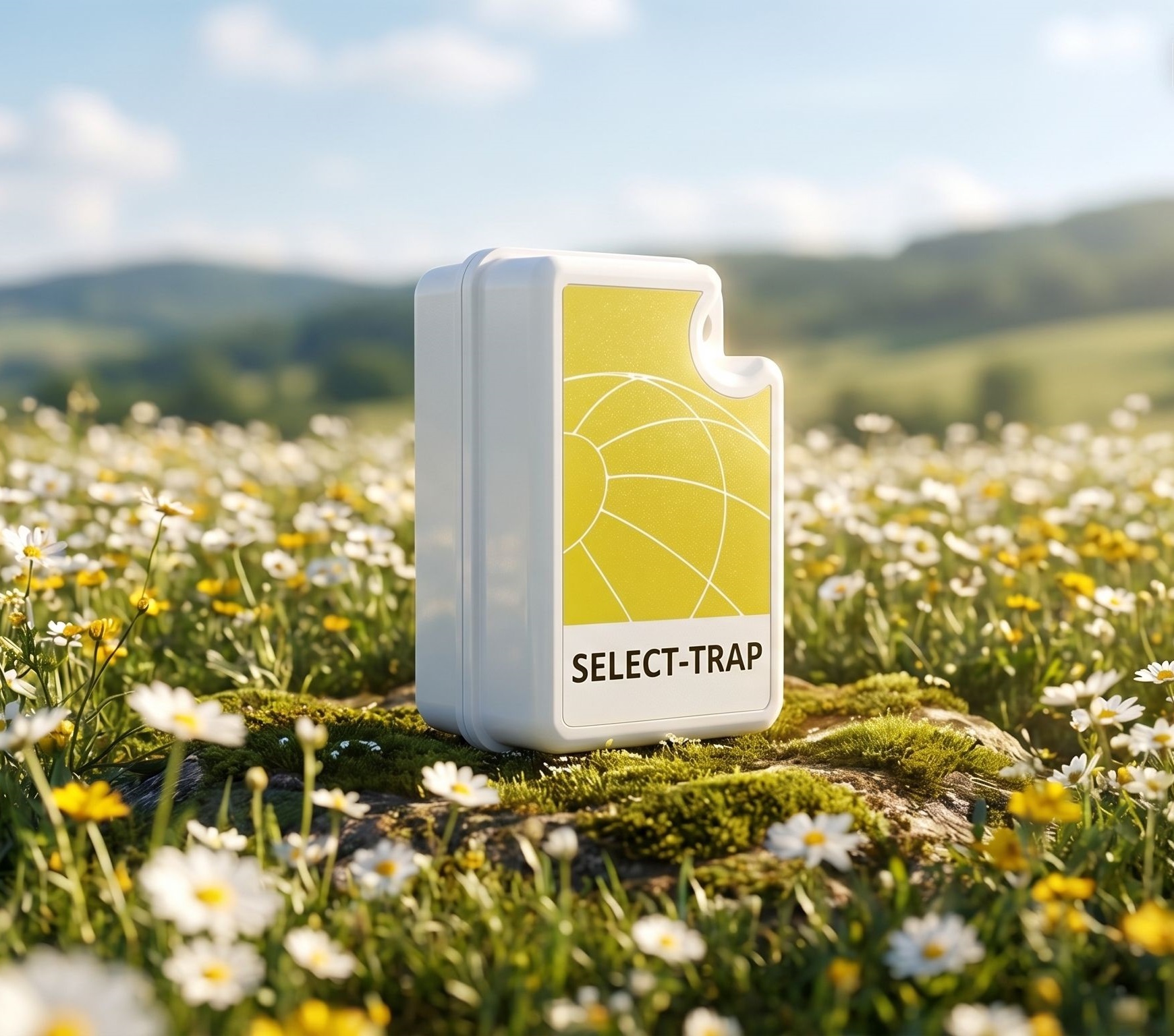
The first selective insect trap that identifies, protects, and acts only when necessary.
Protect pollinators.
Capture invasive or harmful species.
Sort insects with eco-friendly intelligence.
Selective by design. Responsible by nature.
SELECT-TRAP stands out
It doesn't catch insects—it catches the problem.
The future is selectiveEvery species matters,
every decision counts, and
every catch must be meaningful
Protect your interests
It not only protects nature, but also safeguards your work.
In addition to monitoring, learn
Every insect you identify provides valuable information that helps you make decisions.
SELECT-TRAP understands
It measures success in terms of accuracy, protection, and knowledge, not by the number of insects trapped.
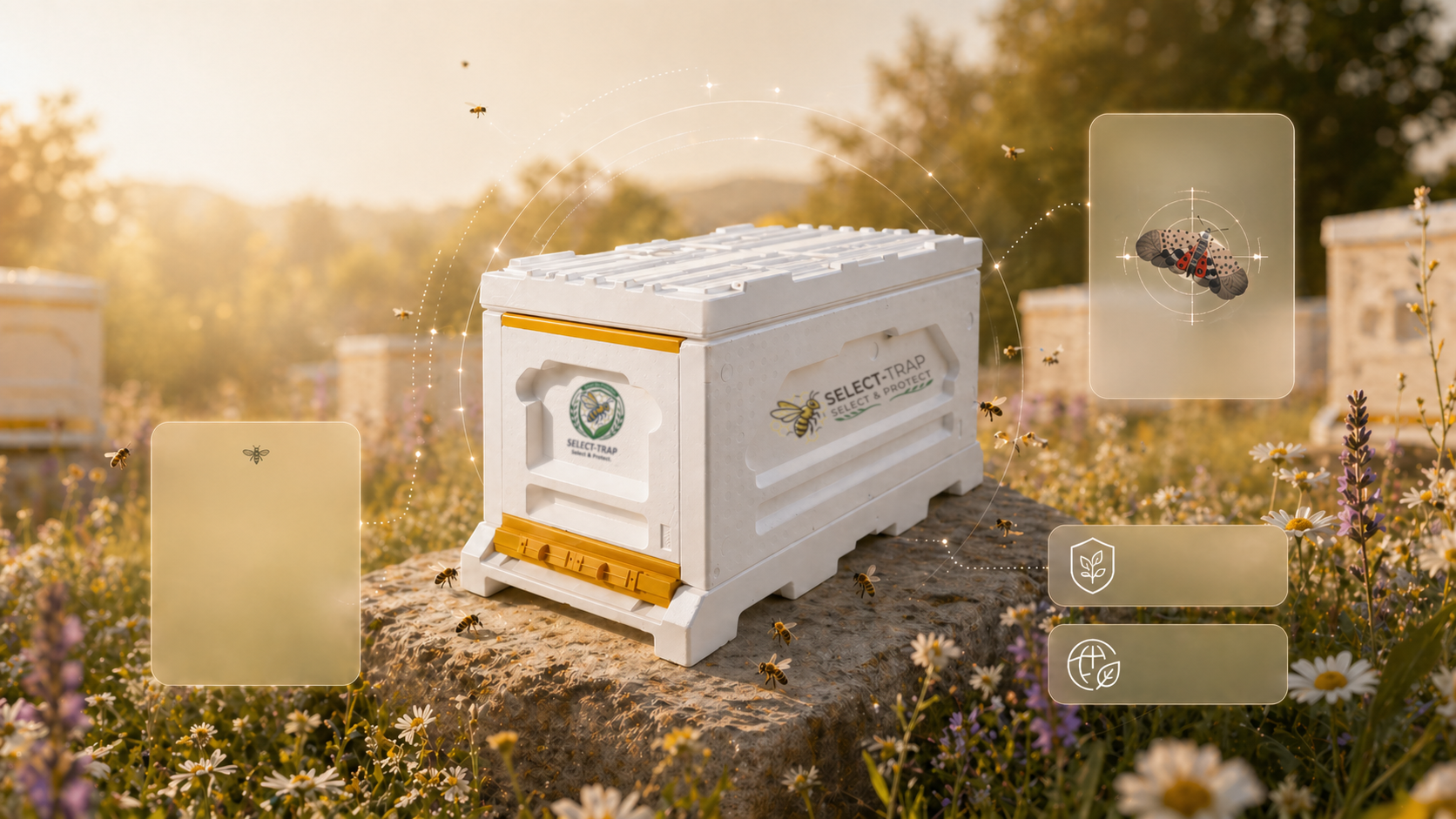
More than just a trap: an advanced tool for selective control and monitoring
SELECT-TRAP transforms an operational need into a superior technological experience. Its design combines precision, automation, and sustainability to target specific species, protect beneficial insects, and provide valuable data for management, research, and decision-making.
Selective precision
It acts only on the target insect, avoiding indiscriminate effects.
Sophisticated Autonomy
It operates autonomously, is configurable, and is connected, reducing the operational burden.
Full visibility
Record images, events, and evidence in real time for monitoring and analysis.
Effectiveness can no longer be based on indiscriminate methods
Beekeeping, agriculture and environmental management need to tackle harmful or invasive species without resorting to methods that endanger bees, pollinators and beneficial wildlife.
Today, true innovation is not just about capturing, but about making better decisions. Acting judiciously is the only way to balance protection, sustainability and operational performance.
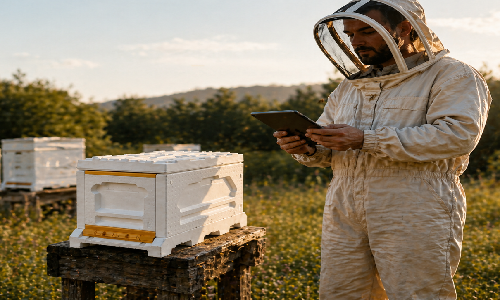
Greater accuracy
Productive and ecological environments require specific responses, not one-size-fits-all solutions.
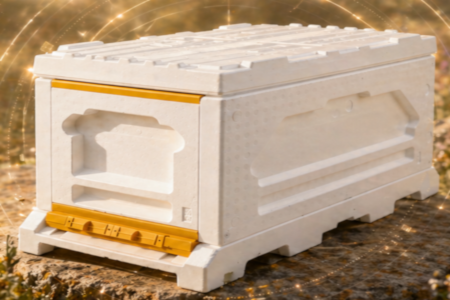
Less impact
Protecting the environment means avoiding harm to beneficial organisms.
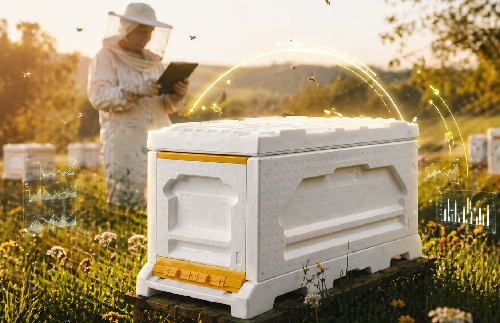
More intelligence
Recording, observing and comparing provides far greater value than simply capturing data passively.
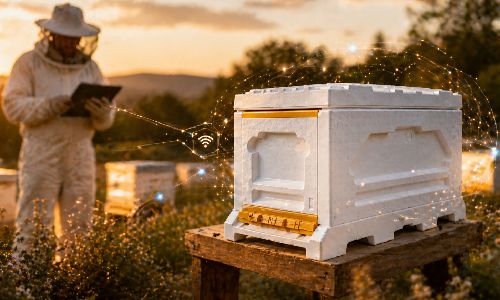
Greater control
Connectivity and automation enhance monitoring and response capabilities.
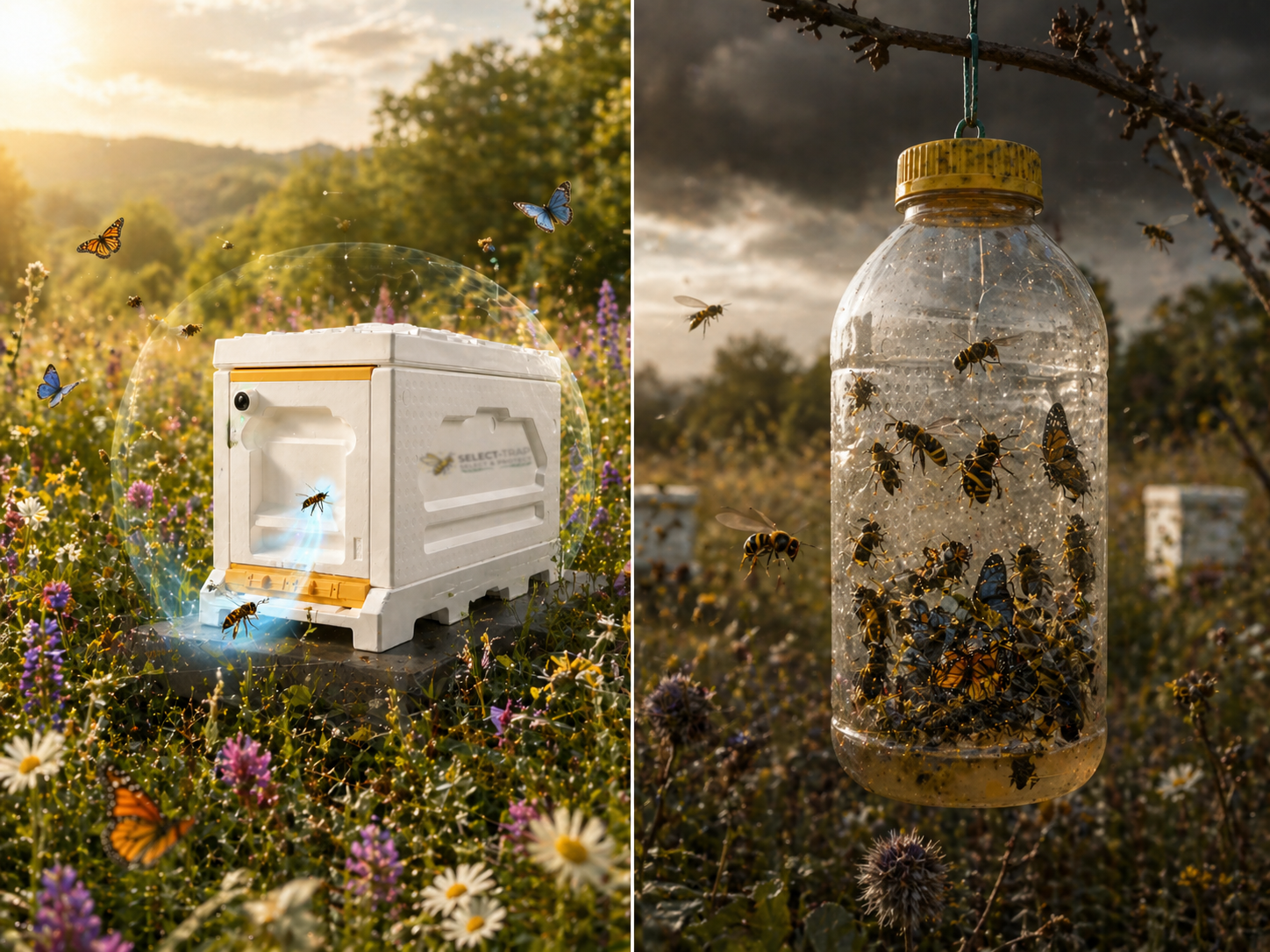
Don’t catch more – catch better.
Most traps catch insects. SELECT-TRAP identifies them.
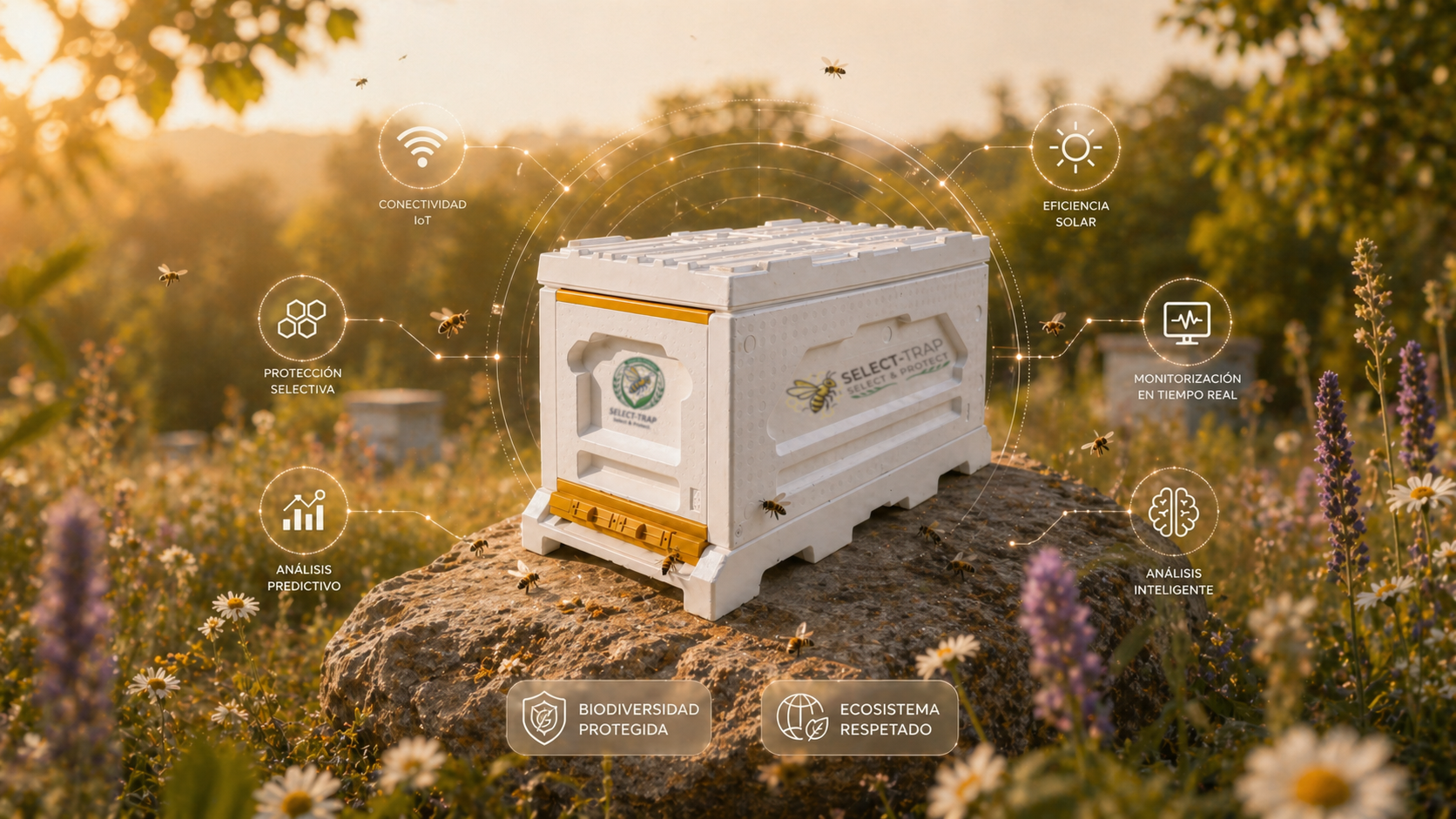
A smart solution that combines sound judgement, precision and technological sophistication.
The system has been designed to attract the target insect, detect its presence, classify it according to configurable parameters, and execute a specific response based on the defined strategy.
|
|
|
|
|
|
|
|
|
|
|
Designed for a new generation of pest management
SELECT-TRAP is the first trap with selective control at source. When the system identifies an invasive or harmful species, it can trigger targeted control strategies focused on the source of the outbreak (for example: invasive species such as Vespa velutina). Rather than acting indiscriminately on the environment or posing a risk to beneficial species, SELECT-TRAP enables a targeted response, designed to reduce the presence of the target species and limit its spread, automatically activating a capture or infestation system to eradicate the source.
As well as controlling, it learns.
Every insect identified provides information. SELECT-TRAP enables the cataloguing of an area’s entomofauna, the recording of species presence, the detection of changes in biodiversity, and the generation of valuable data for environmental decision-making.
This makes SELECT-TRAP more than just a trap: it is a tool for observation, classification and protection. A system capable of answering questions such as:
|
|
|
|
|
|
|
|
|
|
|
In environmental management, knowledge is protection.
SELECT-TRAP
-
Continuous monitoring and control.
-
Real-time data, on any connected device.
A precise sequence, designed to make the best decision for each detection

1. Attracts
The system guides the target insect towards the inspection area using an attraction mechanism designed to maximise effectiveness.
2. Detects
When you access the device, the analysis and logging sequence is triggere
3. Document
Capture images and evidence to ensure traceability and gain useful insights into the environme.
4. Classify
Assess the specimen according to predefined criteria, by species or type.
5. Take action
It retains, releases or acts on the target insect depending on the strategy configured.
6. Communicate
It sends information to the user or the management system in real time for continuous monitoring.
How it works
SELECT-TRAP uses an attraction system tailored to the environment and the type of target insect. An automatic diffusion system disperses the attractant into the environment, allowing it to travel further so that the target insect can detect it more easily. Its design enables the controlled capture of individual specimens for analysis.
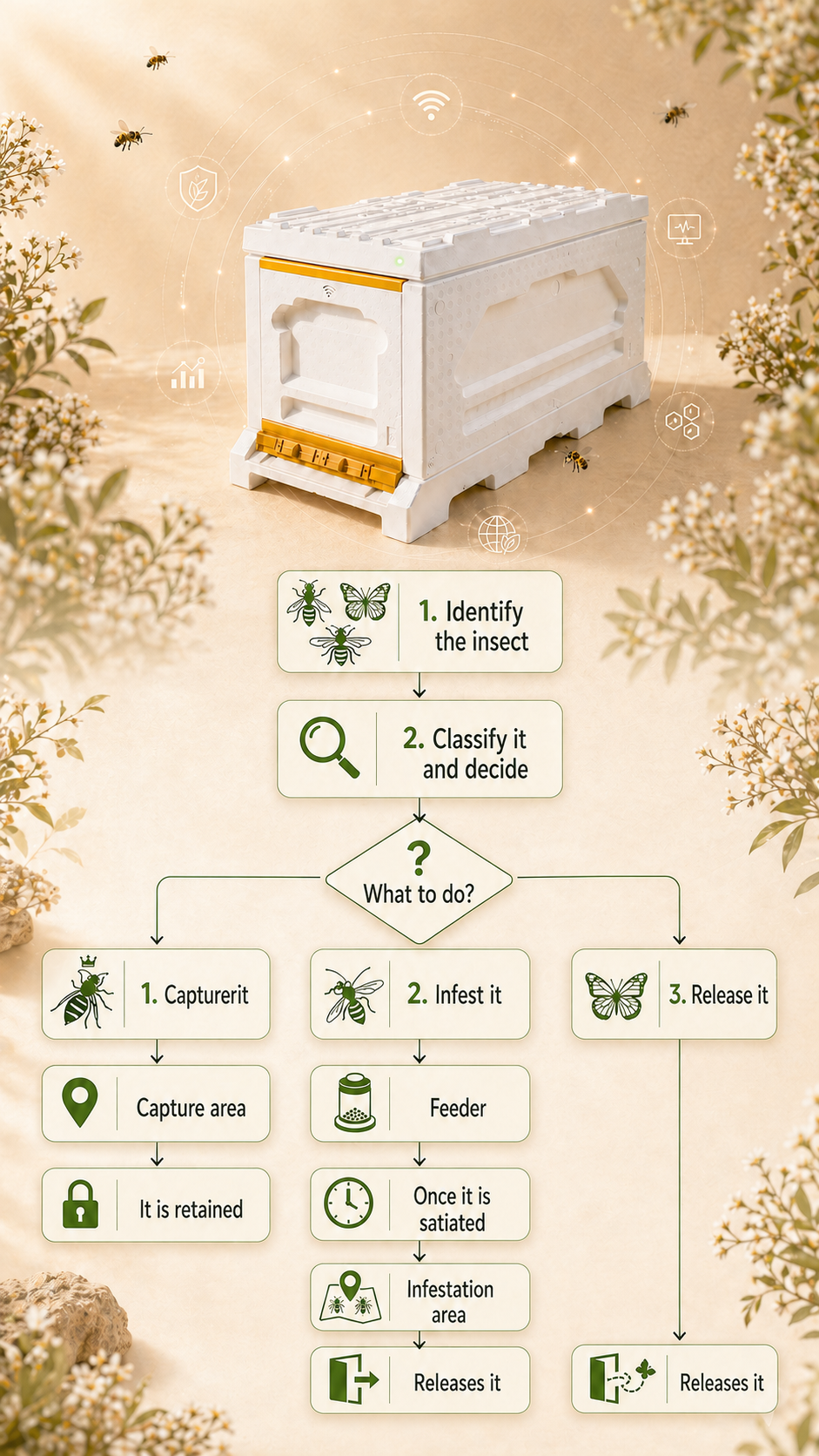
2. Identify
Once the insect is detected at the entrance, state-of-the-art technology springs into action: sensors and artificial intelligence work together to identify the insect and determine whether it poses a threat. The system analyses the insect to identify the species or classify it as a risk group.
3 and 4. Document and Classify
The AI assesses whether the insect is beneficial, neutral, invasive or harmful. This decision enables precise action to be taken, avoiding indiscriminate capture. If the insect poses no threat, the system releases it. If it is identified as a species considered invasive or harmful, SELECT-TRAP activates a specific control response, depending on configurable parameters, such as: user settings, insect type (e.g. Vespa velutina – whether a queen, drone or worker), time of year, user objectives (entomofauna studies, species control, etc.), etc..
- Capture
Depending on the user-defined settings, which establish the capture criteria, SELECT-TRAP directs the insect to an area where it will remain trapped. For example: the capture of queens in the case of invasive species such as the Vespa velutina queen, or entomofauna that is to be captured for subsequent control or study.
- Infest it
If the insect poses a threat, the system feeds it until it is full, so that when it leaves, it is automatically infested. This process is designed to be neither uncomfortable nor traumatic for the insect, ensuring it leaves no chemical or physical traces on the trap that might alert others of its species to a dangerous area. This infestation causes the insect to return (to its nest/hive) so that, upon interacting with others of its species, it infects them and ultimately destroys them. The reason for feeding it is to ensure that, upon leaving, it does not attack other insects (such as bee predators like the Asian hornet) whilst in flight
5. Take action
If the insect poses no threat, a smart sorter directs it to a release outlet.
6. Report
Each sighting can be added to an entomological catalogue, generating useful data for farmers, researchers, government bodies and environmental monitoring programmes.
Advanced technology for more selective control
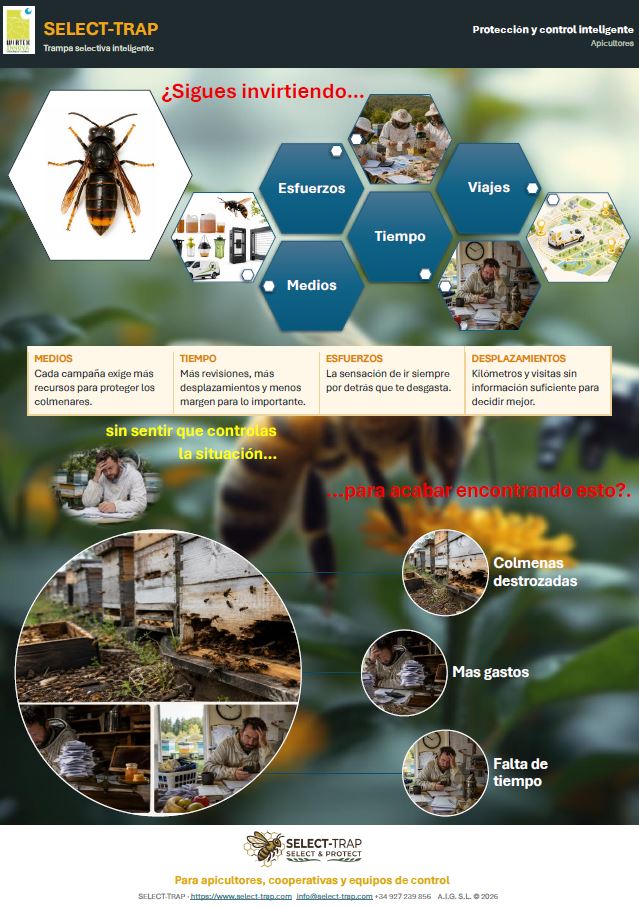
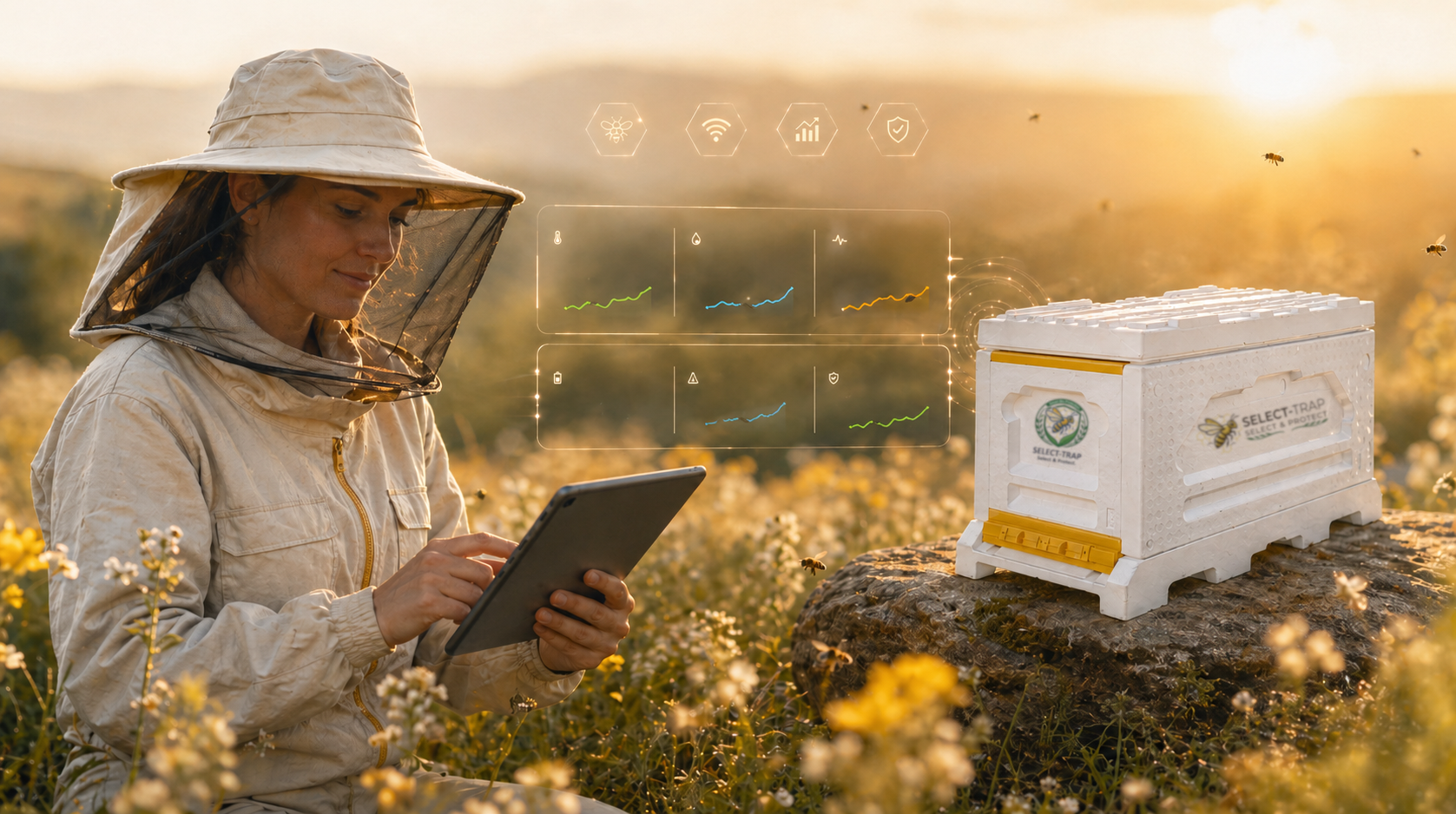
BEEKEEPING
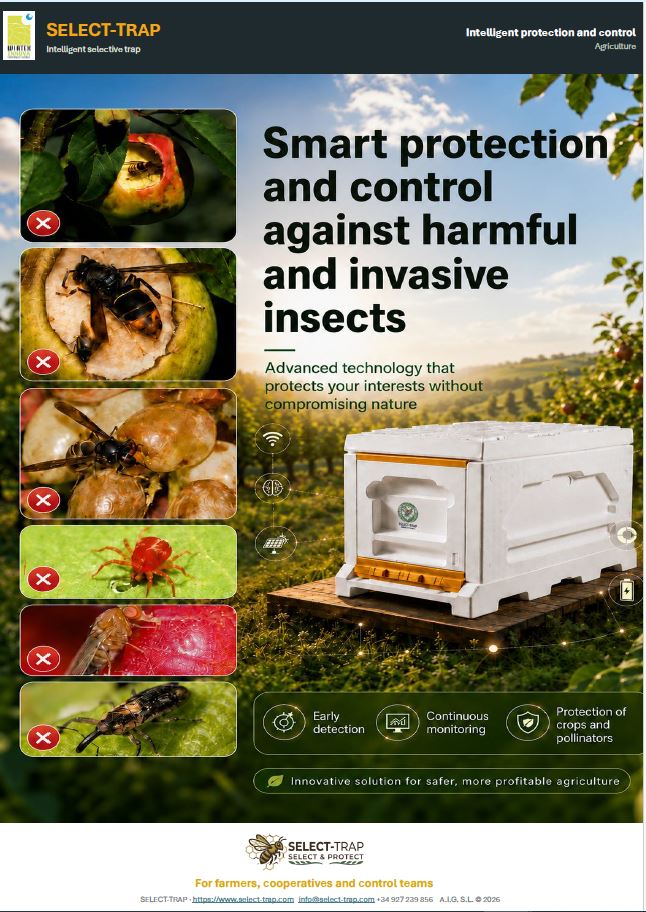
AGRICULTURE
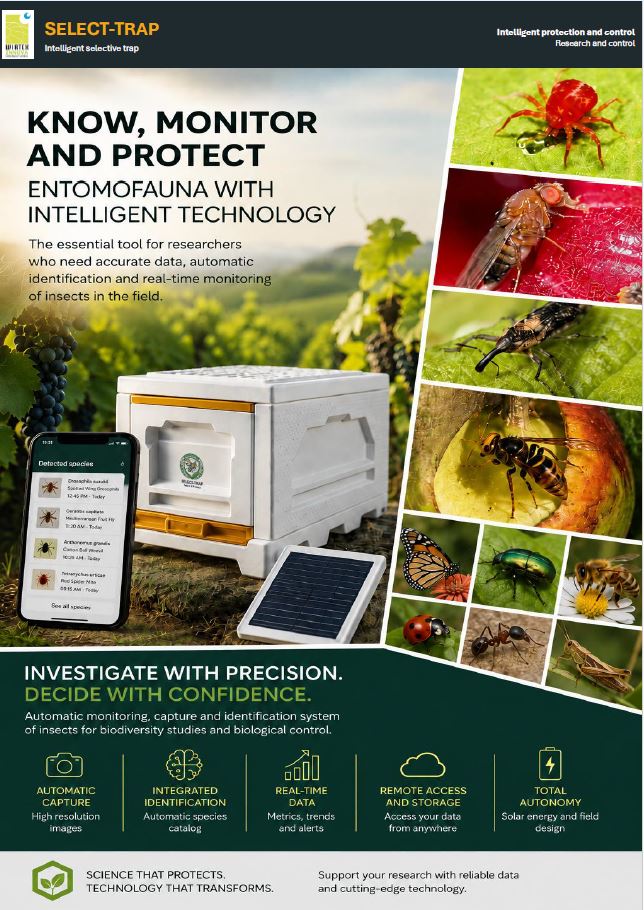
RESEARCH
Four reasons why this solution makes a difference
- Selectivity
Targets only the specific insect, without affecting beneficial insects.
- Automation
Autonomous operation, smart alerts and remote management to reduce operational workload and costs.
- Field intelligence
It doesn’t just act: it observes, records and generates useful knowledge for better decision-making.
- Sustainability
Reduces reliance on pesticides and promotes more ecosystem-friendly management.
A technology with ecological, social and economic benefits
Ecological benefits
- Protection of bees and other pollinators.
- Conservation of biodiversity.
- Reduction of the impact associated with pesticides.
- Generation of data for ecological monitoring.
- Alignment with the green transition.
Social benefits
- Better tools for farmers and beekeepers.
- Strengthening environmental and food security.
- Innovation that benefits the local area.
- Technology applied with a purpose.
Economic benefits
- Reduction in losses caused by pests.
- Lower costs thanks to automation.
- Greater efficiency in monitoring and response.
- Scaling potential.
Versatile by design, scalable by nature
Beekeeping
Protecting hives from insect pests.
Agriculture
Protecting crops from harmful insects without harming pollinators.
Research
Observation, recording and analysis of species presence and activity in the field. Transforms biodiversity into analysable data.
Environmental monitoring
Monitoring and ecological surveillance in various environments. Visible and measurable biodiversity.
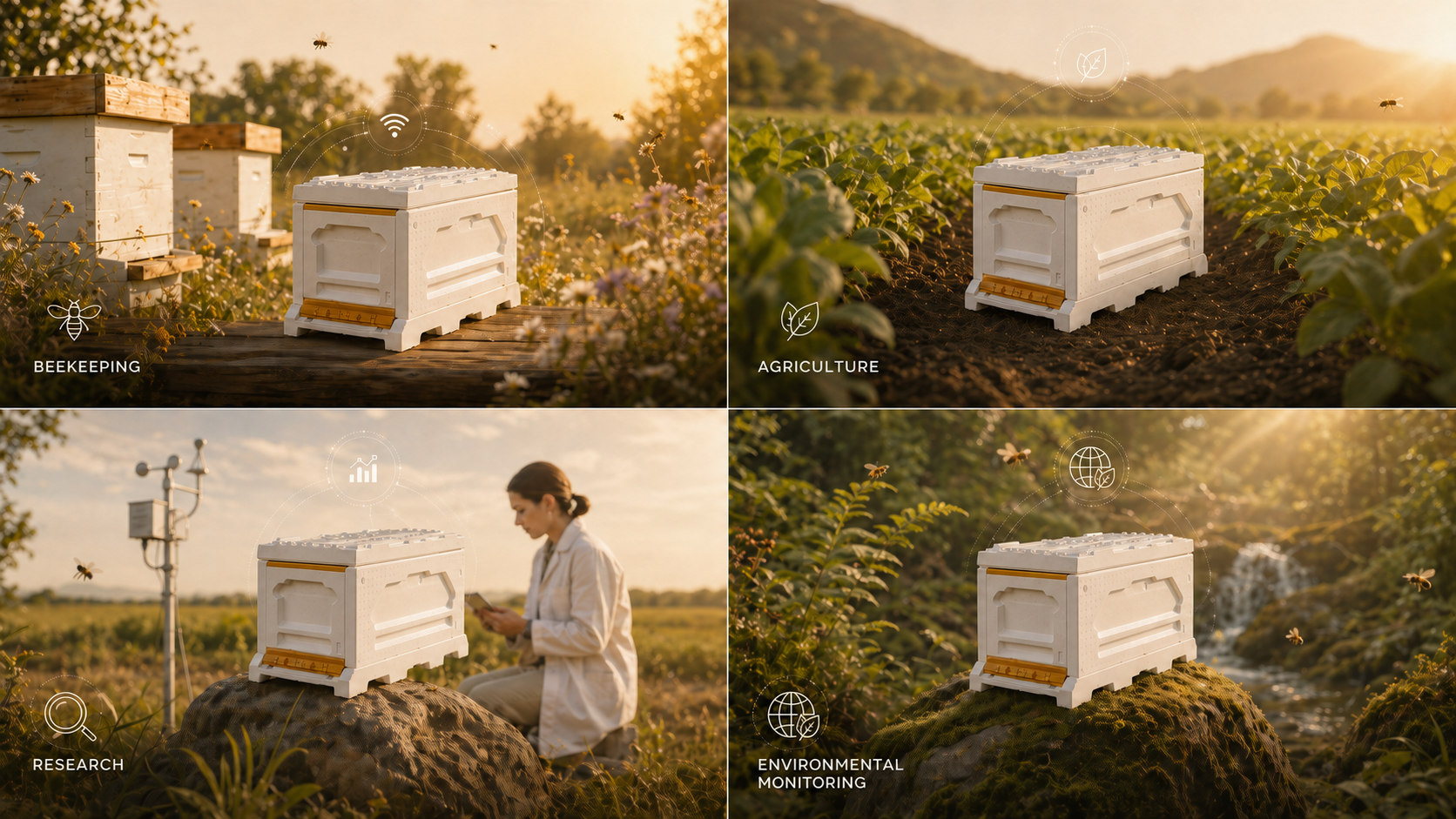
Protecting pollinators means protecting the balance that sustains the ecosystem
Pollinators are essential for the reproduction of wild and cultivated plants and for the stability of numerous ecological and production chains.
The decline in their populations has a direct impact on biodiversity, agri-food systems and public welfare. This solution makes it possible to target specific species without jeopardising the survival of beneficial insects in the environment.
True technological sophistication lies in intervening only when necessary, preserving what is valuable, and turning every detection into useful information.
Physical design, electronics and digital layer integrated into a single solution
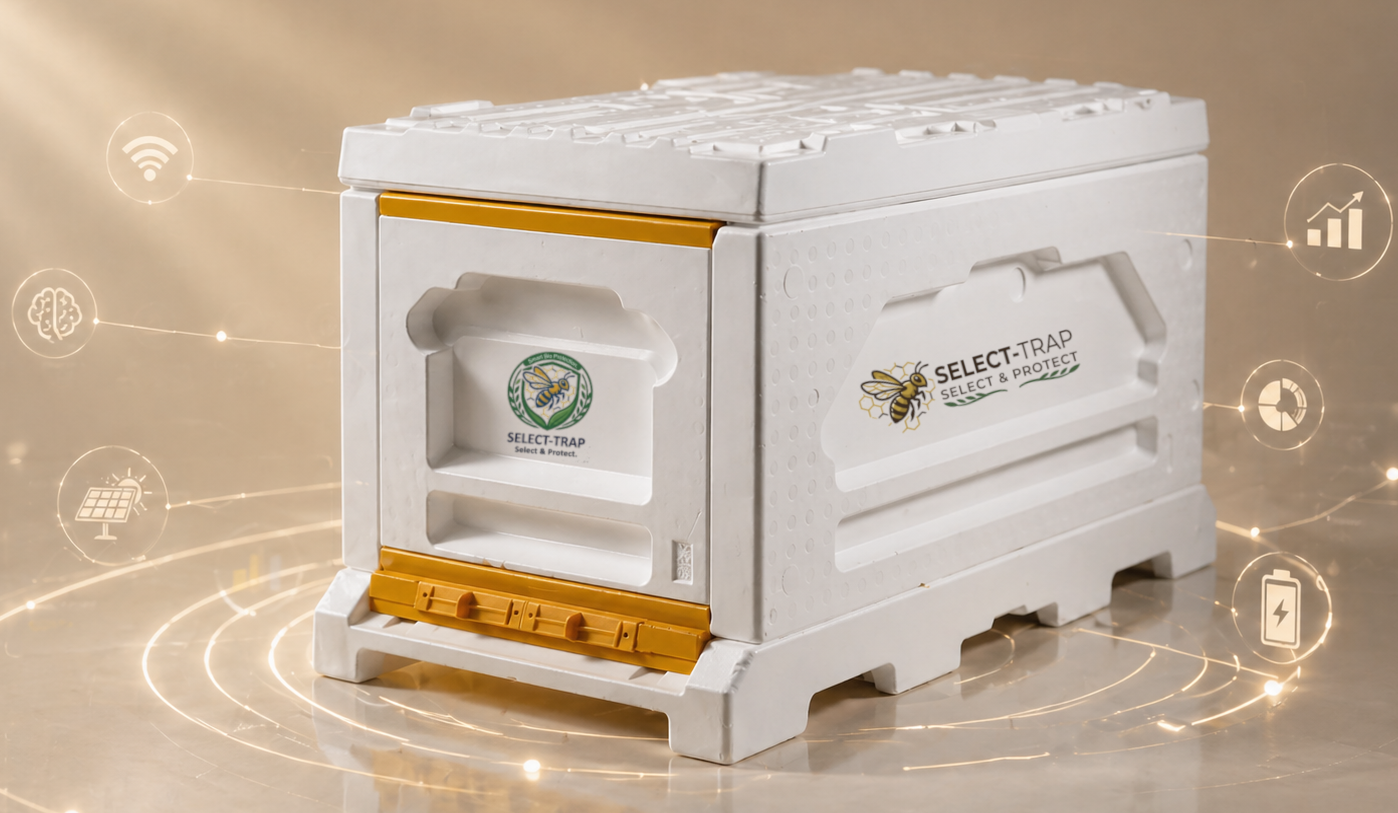
SELECT-TRAP features an architecture designed to operate autonomously, with precision and connectivity in real-world environments, offering continuous monitoring capabilities and configurable operation.
Plug & Play
Quick and easy to install. Its design makes it completely self-contained. Just set it up and you’re ready to go.
Reliable
NVIDIA® AI hardware, high-resolution cameras, advanced sensor technology and secure communication ensure reliability and quality.
Automatic
Depending on how you intend to use it, simply fill the dispensers with the products of your choice. SELECT-TRAP takes care of the rest.
24/7 monitoring
Operating 24 hours a day, 7 days a week, they allow for full control from any device.
Customisable
Set when and how you want to be notified, as well as how you want SELECT-TRAP to behave.
Source of decisions
The information gathered enables you to make better-informed decisions that affect your finances, well-being or academic performance.
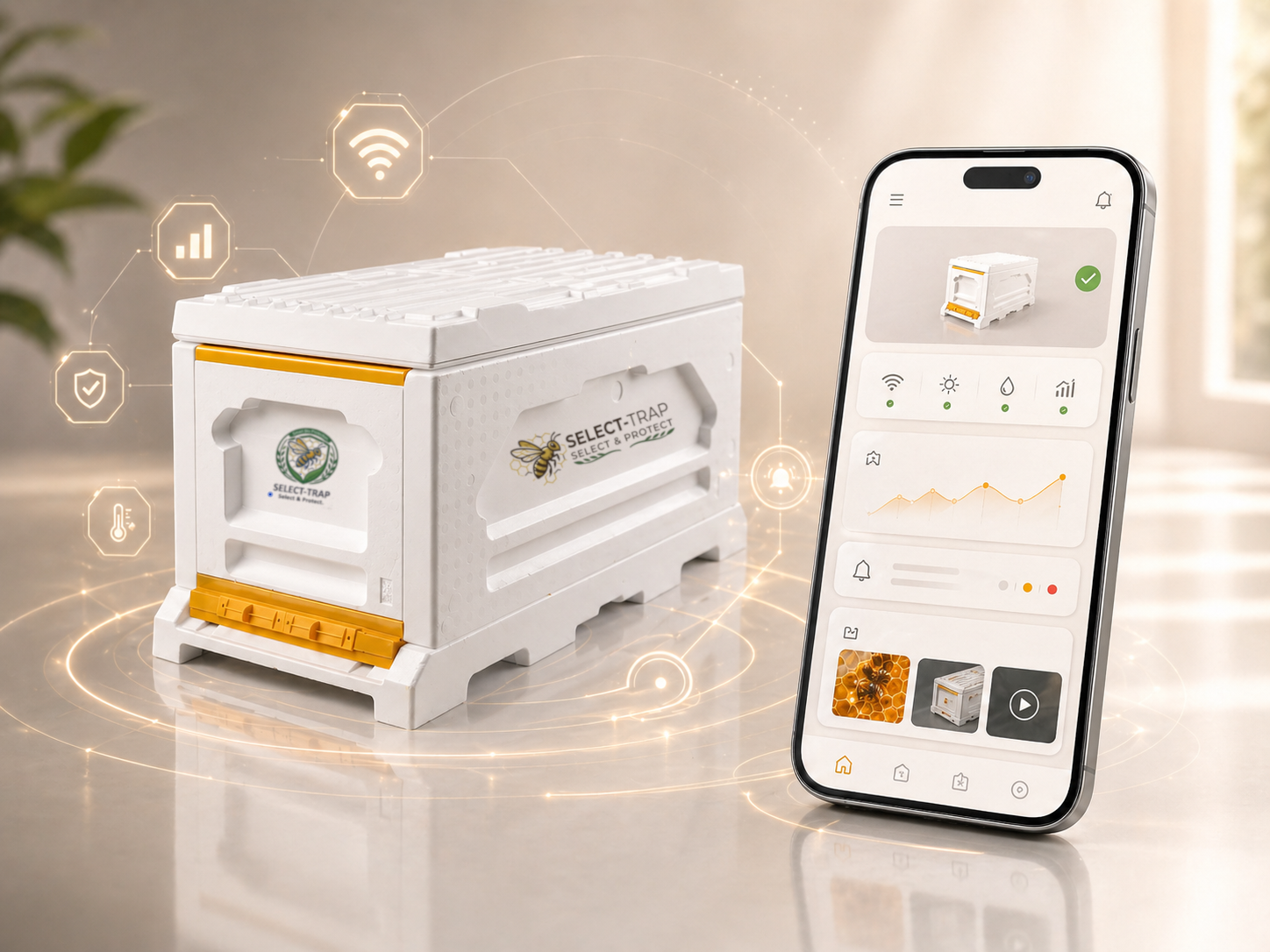
Control, monitoring and decision-making via an app designed to simplify things
The app allows you to monitor the system’s operation, view captures and releases, review images, receive real-time alerts and adjust the control strategy without the need for constant physical intervention.
The future of pest control shouldn’t be about eliminating more; it should be about making fewer mistakes.
Key features
|
Access and Security Real-Time Monitoring and Data Alerts and Notifications Management and Forecasting |
The difference between indiscriminate collection and intelligent management
|
FUNCTION |
TRADITIONAL |
|
SELECT-TRAP |
|---|---|---|---|
|
Selective trapping |
No |
|
Yes |
|
Species-specific configuration |
No |
|
Yes |
|
Image recording |
No |
|
Yes |
|
Entomofauna catalogue |
No |
|
Yes |
|
Remote management |
No |
|
Yes |
|
Real-time alerts |
No |
|
Yes |
|
Impact of weather conditions on inputs* |
Low |
|
High |
|
Risk of infestation to pollinators |
High |
|
Low |
|
Value for research and measurable data |
Low |
|
High |
|
Time investment |
High |
|
Low |
|
Monitoring the efficiency of inputs* used |
None |
|
High |
*Such as attractants, infestation and others.
About us
A.I.G. SL, based in Cáceres (Extremadura, Spain), has been driving innovation and providing technological solutions to various sectors and markets for over 30 years. Founded in 1993, it began its journey in the technology sector by offering solutions to companies in the oil and gas industry through its PRODIGAS division, becoming a technology partner for IBM Spain and the REPSOL Group, as well as providing services to other multinationals such as BP Europe, Galp, and various natural gas distributors and suppliers, both nationally and across Europe. Today, through its original PRODIGAS division, it continues to provide technological solutions to the sector.
In 1999, the WIRTEX INNOVA division was established, which over the last 12 years has focused on IoT and AI solutions, airworthiness systems for unmanned aerial vehicles, the development and creation of electronic prototypes, and process optimisation solutions in the agricultural and forestry sectors, through technological contributions that enable cost reduction and increased productivity in a sustainable manner. Participation in Operational Groups and ongoing collaboration with Technology Centres and other partners has enabled the company to acquire expertise that goes beyond the purely technological, providing practical, cost-effective and real-world solutions to specific problems.
WIRTEX INNOVA is distinguished by the fact that it does not offer ‘off-the-shelf’ solutions; rather, its multidisciplinary approach focuses on the design and implementation of projects tailored to clients’ specific needs. These projects span a variety of sectors and adopt different approaches, always based on the premise of using the most advanced technologies to meet the requirements set out. In the agri-food sector, the company has spoken at conferences, trade fairs and symposia in the agricultural and forestry sectors, as well as at technology centres, and has participated in projects such as INTERNOVAGRO (“Innovation as a path to agro-efficiency, its environmental impact and impact on international markets”) and INFIREX (“Innovation in support of forest firefighting, through the use of unmanned aerial vehicles equipped with Artificial Intelligence”).
Since 2022, at AIG we have been researching technological solutions to assist the beekeeping sector and, more broadly, to protect pollinating insects, particularly in relation to the problems caused by the Asian hornet (Vespa velutina) and the Varroa mite (Varroa destructor).
Frequently Asked Questions
What sets SELECT-TRAP apart from a conventional trap?
SELECT-TRAP does more than just trap insects. It is a selective control system capable of attracting, detecting, sorting, recording and taking action against the target insect in accordance with a predefined strategy. It also features remote connectivity, self-contained power supply and real-time monitoring.
Can you help protect bees and other pollinators?
Yes. The proposal was developed with the aim of targeting harmful species precisely without harming the insects that support biodiversity and natural productivity. Selectivity is one of its key features..
Can it be configured for different species or contexts?
Yes. SELECT-TRAP is designed to adapt to different species or types of insect and to various deployment environments, such as beekeeping, agriculture, environmental monitoring, entomological research, and urban and peri-urban areas.
What are the advantages of this method compared to others?
It enables more precise action, reduces the impact on non-target insects, decreases reliance on pesticides and improves traceability of what is happening in the environment. Furthermore, it introduces a layer of field intelligence that is absent from most traditional solutions. The environmental, social and economic benefits are abundantly clear.
• 100% European Engineering and Manufacturing: Designed, created, and manufactured in Europe.
• Guaranteed Operational Continuity: Permanent stock of original spare parts in our warehouse.
• Minimize Downtime: Immediate logistical response to ensure the continuous operation of your business.
Does it work independently?
Yes. The system is designed to operate autonomously and independently, powered by a battery and a solar panel. This makes it easy to use in the field and reduces the need for constant intervention..
What kind of information do you collect?
SELECT-TRAP is a true ‘black box’ that records everything that happens, both inside and outside the trap: photographs and videos of the insects that have entered the trap, those released, captured and infested, all accompanied by graphical data. At the same time, the status of all sensor systems is recorded, from the points through which the insects have passed to the available quantities of liquids, the battery level, etc..
How is it controlled?
Via any device connected to the network, allowing you to monitor the system’s status, review captures and releases, receive alerts, view photo and video logs, and adjust the settings of the control strategy.
How can I request information and take advantage of an exclusive discount?
It’s as simple as sending an email to info@wirtex.com with your contact details; if you’d like, you can also tell us what you do so we can send you detailed information tailored to your specific needs. There’s no obligation, and you’ll receive priority information about the launch, terms of access, pilot scheme options and the availability of the first units. If you do decide to purchase SELECT-TRAP, you will be offered preferential terms.
FAQ's
How accurate is it at identifying the target insect?
The accuracy rate depends directly on the quality of the AI’s training. Therefore, before activating the feature to 100%, it is necessary to carry out a few days of cross-checking so that the AI can achieve maximum levels of accuracy.
This situation only arises in cases where detections are implemented that the system has not been pre-loaded with. In any case, a result with an accuracy level below 85% is not considered valid, with the average being over 95%.
What happens if it makes a mistake in classification?
Although redundant checks are carried out and very specific and exceptional situations must occur, the worst that can happen is that the target insect is released.
However, a visual and data record is always retained, which allows the AI to be trained and achieve maximum performance.
Does it work just as well with different species or only with a few?
Yes. The system works similarly for any species; logically, the more physical differences there are between species, the greater the reliability of differentiation.
What happens in difficult conditions: low light, dust, rain or a lot of movement?
SELECT-TRAP has been designed so that insect identification takes place in a controlled environment, where external factors have less of an impact. This allows for effective use even in difficult conditions.
Does detection work with a single insect or with high activity as well?
The current design of SELECT-TRAP restricts access to the trap on an individual basis. Until the insect is released or captured, no other specimens are allowed access.
This operation is necessary to prevent the target insects that we wish to trap or infect from perceiving an uncomfortable or hostile environment, or from leaving any kind of mark — chemical or otherwise — that might alert other insects.
If this is of interest to you and you’d like to stay informed, as well as enjoy other benefits.
Please send us a message using this form or an email to info@wirtex.com, providing your contact details and, if you wish, a description of your business.
We do not use, sell or pass on your details to third parties. They are used solely to keep you informed. We will not call you unless you tell us otherwise.